Most people experience imposter syndrome during the PhD journey, as in many other parts of life. But it often feels sharper when undertaking a doctorate later in life. Perhaps it’s because the weight of accumulated responsibilities, the awareness of time, and the sense of stepping into a world that doesn’t always expect you to be there all converge at once. In those moments, self-doubt is not limited to the work ahead. It also raises questions about whether you still belong in a space that seems to run on different rhythms after a long break from the student life.
Age has a way of amplifying the questions we ask ourselves. Not only the quiet doubts like ‘Am I good enough?’ or the sharper fear of ‘Am I a fraud?’ but also the deeper reflections, ‘Is this the best use of my time at this age? Will my work matter at all?’ It’s this layering of everyday self-doubt with bigger life questions that makes imposter syndrome at this stage feel so complicated.
A Conversation That Stayed With Me
Recently, while on an archival research team trip to a museum, I found myself in a conversation that has stayed with me. I mentioned to a colleague, who is also a good friend, that after our visit, I’d be rushing off to join my husband and son at a school’s open day. We’re preparing for my son’s admission into secondary school, and I didn’t want to miss it.
She nodded knowingly, recognising the challenge of juggling parenting alongside doctoral research, then paused before asking, “So, is he your only child?”
I laughed and shook my head. “No, I actually have two older daughters as well. They’ve both finished their master’s degrees and are now working full-time.”
Her eyes widened. “You’re joking! I’d never have guessed. You don’t look that old or like you’re carrying that much responsibility!”
Outwardly, I may blend in with the late-twenties and thirties students who dominate postgraduate research, but the truth is that my life looks very different. Behind the deadlines and seminars are layers of responsibility: parenting, family commitments, and years of professional and lived experience that shape how I walk this PhD journey.
That conversation reminded me of something important. Often, we tell ourselves we are falling behind, unable to keep pace with those who seem to have the whole world ahead of them. But while we may compare ourselves and fear we can’t keep up, others might be looking at us with admiration, wondering how we carry so much and still manage to thrive.
This is the paradox of imposter syndrome for older PhD students. We may see incapacity in ourselves, but others often see capability and resilience.
The Different Clock Older Students Face
That feeling of being “behind” is often tied to time. I remember being an undergraduate in Nigeria, sitting in a lecture hall and listening to a young academic teaching drama. He was widely celebrated as the youngest PhD holder in the country at the time, having completed his doctorate at the age of twenty-seven. I used to look at him with wonder, marvelling at the years he had ahead of him to build a career in academia.
Now, as a doctoral student myself but past 50, I sometimes think of that memory with bittersweetness. Where he had decades to grow, publish, and climb, I feel the opposite pressure, like there isn’t enough time to do so much and spend in academia. And I know I’m not alone. For many mature PhD students, the doctorate doesn’t stretch into a 30-year runway of possibilities. It is condensed and urgent. The clock ticks differently.
This doesn’t have to be discouraging, but it does change the question we carry. Instead of asking, “How far can this degree take me?” we can ask, “What can I make of it with the time I have?”
Challenges and Tensions
Of course, imposter syndrome doesn’t vanish entirely. Sometimes it sneaks back in when I sit across from supervisors younger than myself. In those moments, I feel the sting of “what if”. What if I had done this earlier? What if I hadn’t taken the detours? What if I’d had those decades to grow?
If I had gone straight through postgraduate study after my first degree, like many of my coursemates, I might by now be a professor. Several of them are. They made the linear climb. I didn’t. My path wound through raising children, building family, and supporting others, before turning back toward academia.
Institutions also aren’t designed with us in mind. Career services, networking events, and funding pathways often assume the traditional doctoral trajectory of mid-twenties and thirties, early career, decades ahead. For mature students, that framework can feel misaligned, even alienating.
And then there’s the quiet question from others: Why now? Why spend years on a doctorate when the “career return” will be minimal? What they miss is that for many of us, the calculus is different. The return isn’t measured in salaries or promotions, but in meaning.
Shifting Motivation: From Achievement to Impact
And so the focus shifts. Where once imposter syndrome might whisper, “You’re late,” experience pushes back with a new perspective: “And what if I am? Maybe so, but what I do still matters.”
This shift changes motivation, too.
Younger students often chase achievement like the next publication, the next fellowship, or the next step on the ladder. For me, and for many others in my position, the motivation goes beyond the next achievement. The motivation is impact.
I ask myself different questions: What contribution will my dissertation make to the world? How will this research serve communities, industries, or even my own children and their generation? How do I want to be remembered in this field, however briefly I may occupy it?
That doesn’t mean ambition disappears, but it transforms. It becomes less about climbing and more about giving. Less about recognition and more about resonance.
At this stage, my PhD feels less like a launchpad and more like a capstone. It is not the beginning of a long career but the gathering together of strands, professional, personal, and intellectual, into something coherent. It is the chance to pursue questions deferred, to translate lived experience into scholarship, and to leave behind work that might still matter long after I’ve left the seminar room.
This reorientation also changes how I approach the journey itself. Success is no longer measured only in outputs or accolades but in the alignment between my research and my values. Each seminar I attend, each chapter draft I write, and even each moment of struggle carries weight because it feeds into something larger than me. The pursuit becomes less about proving I deserve to be here and more about ensuring that what I leave behind, in knowledge, in example, and in legacy, will outlast me.
Strengths of the Older PhD Student
So, even within those doubts, there are strengths. Experience has shown me that what feels like a weakness often looks like strength to others. When younger colleagues marvel at how I balance children, marriage, and research, I’m reminded that what feels like a burden to me might look like resilience to them. Where I see lost time, they see lived wisdom. Where I see strain, they see strength.
And perhaps that’s the gift older PhD students carry into academia beyond just knowledge: having the lived context that surrounds it.
Rewriting the Narrative
It’s easy to think of myself as an anomaly, an outlier who arrived too late to the race. But that framing misses the richness of what I bring. I am not a latecomer; I am a knowledge steward. For me, the doctorate is not a ticket to a career but a vessel for legacy.
And in that legacy, imposter syndrome fades. What matters is not how late I arrived but what I choose to leave behind.
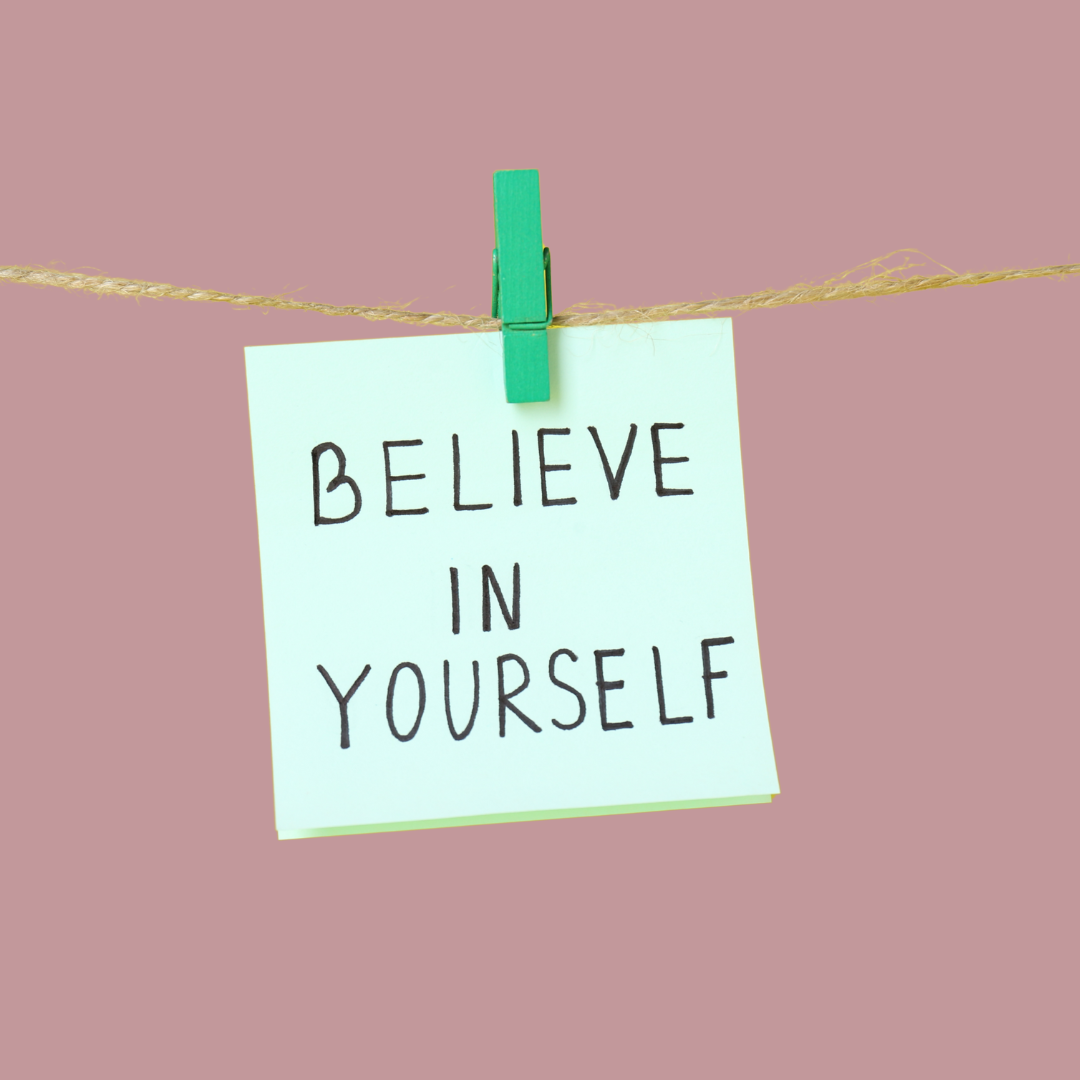
Ten Affirmations for the Journey: A Reminder to Believe in Yourself
We know imposter syndrome is real, but our presence is also proof that it can be overcome, not by ignoring it, but by reframing it. One way I do this is by reminding myself of truths that counter the doubts. If you, too, are walking this path later in life, here are words you can carry with you:
- I belong in this space because my perspective is valuable.
- My years of experience are not baggage; they are strength.
- I bring depth and context to my research that only lived life can provide.
- I am not late; I am right on time for my own journey.
- Balancing family, work, and study is not a weakness; it is proof of resilience.
- The questions I pursue now are shaped by wisdom that could only come with age.
- My contributions matter, even if they don’t fit traditional academic timelines.
- I am allowed to take up space here, as much as anyone else.
- My PhD is not just about career; it is about meaning and legacy.
- I am enough, exactly as I am, to finish this journey.
These affirmations are reminders of the strength, wisdom, and purpose we carry into our doctoral journeys. Holding onto them allows us to keep moving forward, even when doubt whispers otherwise. And that, more than any title or credential, is the real victory over imposter syndrome.
I am rooting for you.
Your mature PhD supporter,
Adeola Eze
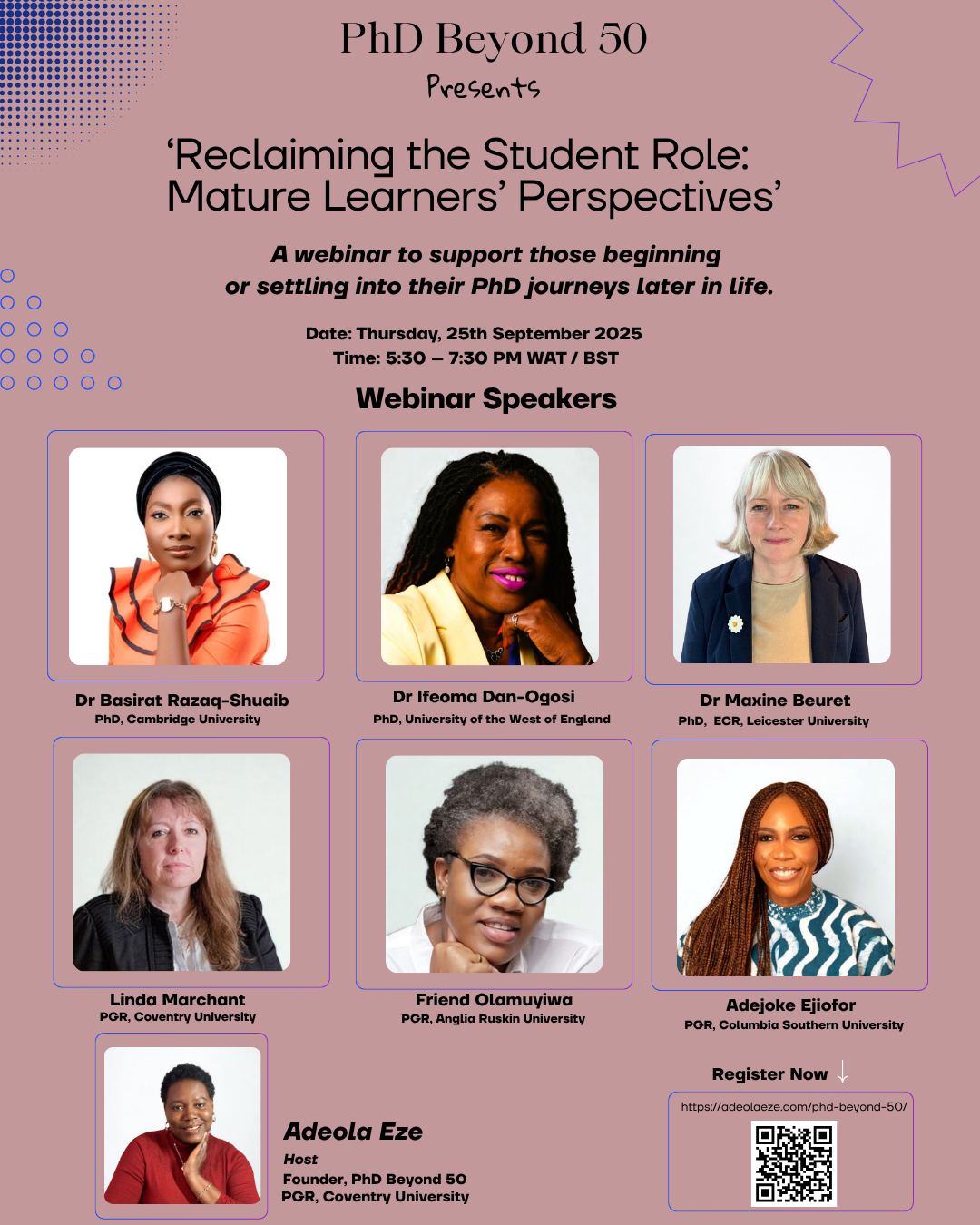
It’s September and I am so excited about this upcoming free webinar – Reclaiming the Student Role
If you’re finding your way around the complex realities of doing a PhD later in life, possibly balancing study with work, parenting, caregiving, or simply finding your way back into academic life, this free webinar is for you.
Title: Reclaiming the Student Role: A Mature Learner’s Perspective
Date: Thursday, 25th September 2025
Time: 5:30–7:30 PM WAT / BST
Location: MS Teams
Hosted by me and the PhD Beyond 50 community, this webinar is a supportive space created for mature and non-traditional PhD students; those who’ve returned to study after years in professional, family life, or leadership roles, and are now navigating an identity shift, a change in pace, or even just the feeling of being out of place.
I’ll be joined by an inspiring panel of mature PhD students and graduates who will be sharing their honest experiences and strategies for:
- Reframing identity from expert to student
- Managing energy and expectations
- Staying connected to your purpose
- Building support systems that work
- Creating academic visibility without overwhelm
This won’t be a formal academic lecture. It’s real talk. Real experiences. Real encouragement.
 Click here for more information and register
You don’t have to figure this season out alone. We’re building community, and I’d love to have you there.